
In European, American, and Canadian legislation, clear references are made that static electricity constitutes a potential ignition source for activities carried out in flammable and combustible atmospheres, which implies a significant risk to the health and safety of workers.
Industry standards should be followed so that risks of static ignition are identified and appropriate precautions are taken. Two leading international guidance documents are CENELEC’s CLC/TR 60079-32-1 “Explosive atmospheres – Part 32-1: Electrostatic hazards, guidance” (2015) and the National Fire Protection Association’s NFPA 77 “Recommended Practice on Static Electricity”.
Both of these documents identify EX / HAZLOC processes that present ignition risks and the measures that can be adopted to mitigate those risks. The simplest and often most reliable way to reduce the risk of an electrostatic spark igniting is to provide a ground connection. Grounding ensures that equipment does not create an electrostatic charge when in contact with statically charged liquids, powders, and gases, or when located near other electrostatically charged objects.
To safely transfer electrical charges from equipment to the ground, the most critical factor is ensuring the total electrical resistance present in the path from the equipment requiring static grounding protection to a verified grounding point. Both CLC / TR 60079-32-1 and NFPA 77 specify a maximum resistance of 10 ohms in metal circuits, providing the EX / HAZLOC industry with a clear benchmark to follow as a safety function for grounding and the dissipation of static electricity.
Max 10 ohms to ground
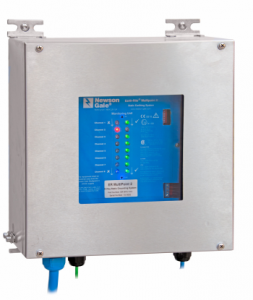
Earth-Rite MULTIPOINT II is a system that users can customize for a wide range of EX / HAZLOC processes requiring static grounding of metal equipment. Whether the metal equipment is a railcar, an IBC, a drum, or potentially isolated parts of interconnected process equipment, the Earth-Rite MULTIPOINT II will only indicate a green light when the electrical resistance in the grounding circuit is 10 ohms or less.
One of the primary advantages of the Earth-Rite MULTIPOINT II is its ability to actively monitor the ground status of up to eight pieces of equipment. A standard system typically includes an interlocking function for only one equipment space, but the Earth-Rite MULTIPOINT II has the capability to monitor eight sections simultaneously, resulting in lower installation costs. The Earth-Rite MULTIPOINT II monitoring unit and remote indicator stations can be installed in Zone 0. The power supply unit can be installed in Zone 2.
The Earth-Rite MULTIPOINT II consists of a monitoring unit featuring a series of red and green LED indicators that verify when equipment requiring static ground protection has a resistance to a verified grounding point of 10 ohms or less. In addition to the LED indicators in the monitoring unit, process operators can monitor this on remote indicator stations that can be placed closer to the hazardous area. Each indicator station provides operators with a visual “GO / NO GO” reference, informing them if the resistance in the static grounding circuit is low enough (less than 10 ohms) to proceed with the process.
The image below demonstrates the installation flexibility. The system is specified to ground four mixing stations (1 to 4) and two filling stations (5 and 6). Each mixer is interconnected with an individual relay linked to the grounding monitoring channel; thus, if the resistance between the grounding clamp connection to the drum and the verified grounding point exceeds 10 ohms, the mixer will not operate.
Channels 5 and 6 are grouped via the system’s group relay so that if one of the drums is not grounded, the pump feeding the filling station is immediately shut off, thereby stopping the delivery of electrostatically charged liquids to the drums.
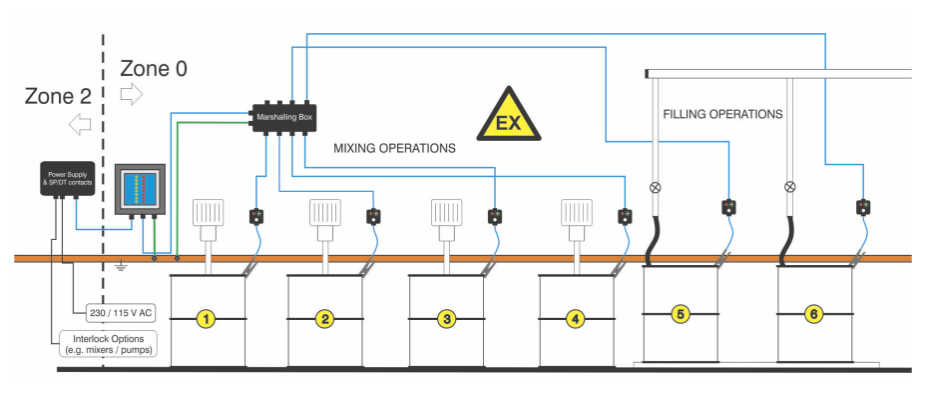
The economic benefits are clearly visible compared to the total purchase price of six individual generic static grounding systems, and there are several reasons why installation costs are minimized compared to other grounding solutions. The remote indicator stations are powered by built-in intrinsically safe circuits fed directly from the monitoring control unit.
This is more cost-effective than expensive Ex-approved indicator stations that require power supply via mains current in the 230 V to 110 V AC range. In addition to the reduced cabling and purchase costs for the Earth-Rite MULTIPOINT II indicator stations, they consume significantly less power than power supply stations.
This article is the copyright of Newson Gale – ©Copyright Newson Gale 2019.