
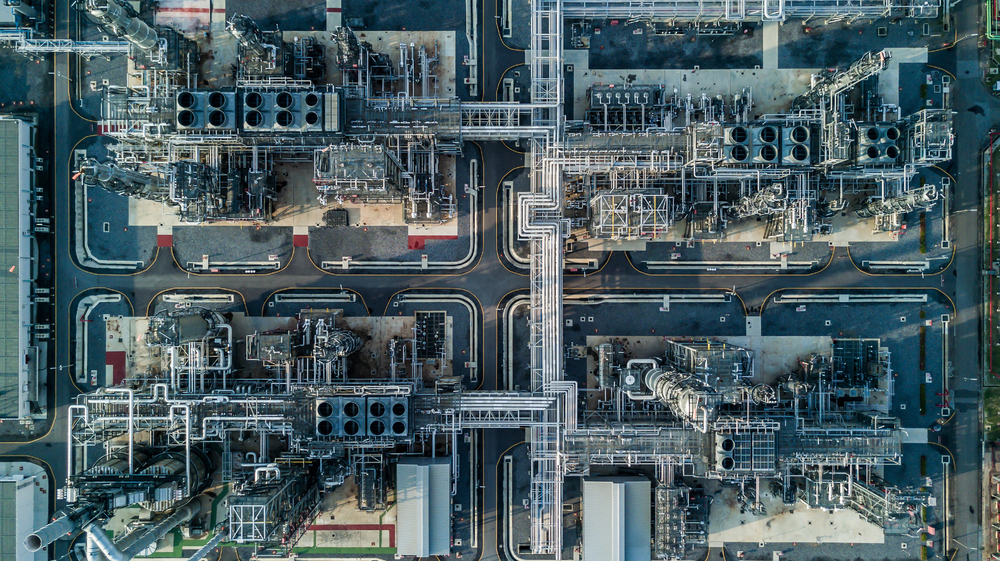
The risk level dictates the choice of equipment
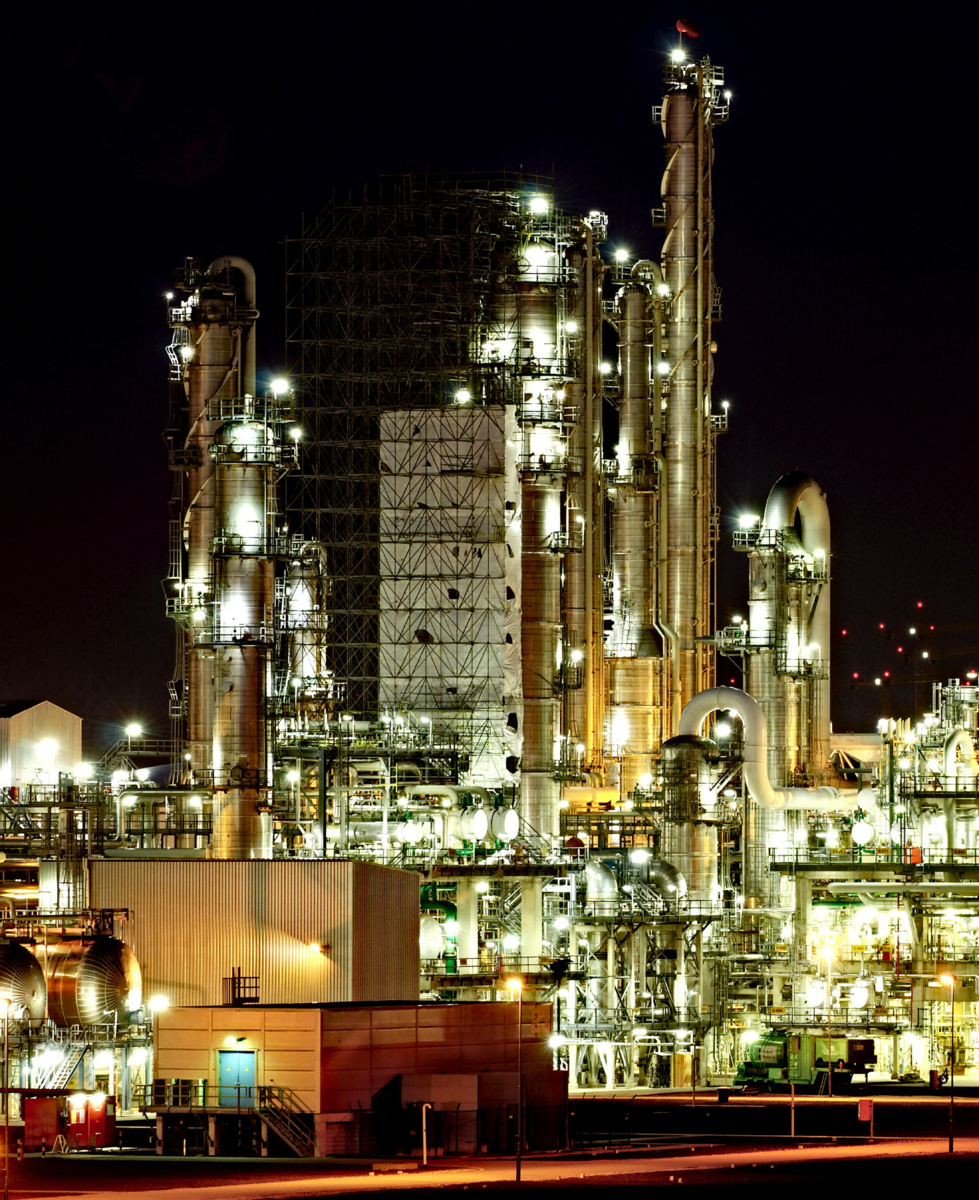
When flammable goods* or combustible dust are stored or handled, they may give rise to an explosive atmosphere. Equipment can ignite such an atmosphere with, for example, a spark or a hot surface. It is important to use explosion-protected equipment, but this is not enough. It must be of the correct design to be safe with the substances and in the hazardous area where it is installed, and it must be maintained so that it remains safe.
Different substances ignite more or less easily depending on temperature and spark energy, and have different abilities to transmit an igniting flame through a gap. Therefore, flammable goods are divided into temperature classes and explosion groups. How often and for how long an explosive atmosphere may be present also affects how equipment needs to be constructed to provide satisfactory safety. Where an explosive atmosphere exists only briefly and rarely, reasonable safety can be achieved with much simpler methods than where it exists frequently or for long periods.
Areas with a risk of explosion can be found in, among others:
– Painting facilities – Refineries – Paint industry – Petrochemical industry – Explosives industry – Pharmaceutical industry – Chemical industry – Food industry – Printing industry
– Heating plants for LPG and natural gas
– Sewage treatment plants
– Ports and airports
– Boat industry
– Fuel depots and stations
– Sugar mills
– Mills, silos, bakeries, etc.
– Paper mills, loading and unloading areas
– Forestry industries
– Printing houses
To be on the safe side, you can always download or order current regulations and standards from the Swedish National Electrical Safety Board, the Swedish Civil Contingencies Agency (MSB), the Swedish Work Environment Authority, and SIS Publishing.
ATEX – Regulations for equipment and occupational safety
Since 2003, countries in the EU/EFTA have had a common regulatory framework for areas with explosive gas and/or dust atmospheres. This is called ATEX (ATmosphères EXplosibles). It sets requirements for both products and occupational safety. The Swedish regulation for mechanical equipment is the Swedish Work Environment Authority’s AFS 1995:5, and for electrical equipment, there is the National Electrical Safety Board’s ELSÄK-FS 1995:6. These regulations implement EU Directive 94/9/EC, which many call ATEX 95 (formerly known as ATEX 100a).
Swedish regulations on work organization and the choice of equipment in explosive atmospheres apply to flammable goods*. These are issued by the Swedish Civil Contingencies Agency (formerly the Swedish Rescue Services Agency) SRVFS 2004:7, and for other substances that can form an explosive atmosphere, primarily combustible dust, the Swedish Work Environment Authority’s AFS 2003:3. They implement EU Directive 1999/92/EC, often called ATEX 137, with national amendments.
Requirements for new equipment
To be placed on the EU market, all equipment (with an inherent ignition source) for all zones must be Ex- and CE-marked. This applies to both mechanical and electrical equipment, for both gas and dust atmospheres. (Before 2003, requirements for specific marking/approval only applied to electrical equipment for Zone 0, Zone 1, and coal mines.)
Equipment is classified depending on whether it is intended for hazardous areas with gas atmospheres (G), dust atmospheres (D), and/or coal mines (M). It is also divided into equipment categories 1, 2, or 3 depending on its safety level (M1 or M2 for coal mines). The rules aim to ensure that the risk of ignition—i.e., the simultaneous presence of an explosive atmosphere and an ignition source—is sufficiently low.
Existing equipment and spare parts
Equipment already in operation before 2003-07-01 is not affected by the new requirements. (A prerequisite is, of course, that the installation is safe and was installed according to the regulations in force when it was put into operation.)
Equipment that was already placed on the EU market by 2003-06-30, such as stock held by distributors or end-users, and was ready for use, does not need to comply with ATEX to be put into service now. The standard interpretation is that it may not be used for new installations, as equipment that requires installation is not considered ready for use.
Requirements for workplaces and work equipment
Employers are obliged to provide preventive protection against explosions to ensure the health and safety of employees. This is achieved through both technical and organizational measures. Workplaces with explosive atmospheres must meet the minimum requirements in SRVFS 2004:7 and AFS 2003:3, respectively.
This means that an explosion protection document must be available, detailing the risks present, which areas are Ex-classified, and how sufficient safety is achieved and maintained. Ex-areas must be marked with a warning sign.

Risk assessment and classification
To know how to work safely and to be able to select and install equipment with an appropriate safety level, a risk assessment is conducted. If there is a significant risk of an explosive atmosphere, the area is classified—i.e., divided into zones depending on how often an explosive atmosphere occurs. For areas with flammable goods, the explosion group and temperature class are determined. For areas with combustible dust, the ignition temperature for the dust atmosphere and dust layers is primarily determined. The classification is documented in a so-called classification plan. To obtain a permit to handle flammable goods, a classification plan is required, and a director must be appointed who is responsible for the handling. The classification plan is a legal document for which the person responsible for handling within the explosive environment is accountable and must have signed, even if someone else prepared the proposal for the classification plan.
Occurrence of explosive gas atmospheres
The handbook for SRVFS 2004:7 provides support in applying the requirements for handling flammable goods.
Explosive gas atmospheres can occur during:
1. handling of flammable gas;
2. handling of flammable liquids that release vapor (gas) into the surroundings at the handling temperature;
3. handling of flammable liquids that form a mist (aerosol). Whether a flammable liquid gives rise to a zone depends, among other things, on the liquid’s flash point. The flash point is the lowest temperature at which the liquid releases vapor (gas) in such a quantity that its mixture with air can be ignited. Flammable liquids are divided into four classes based on their flash point.
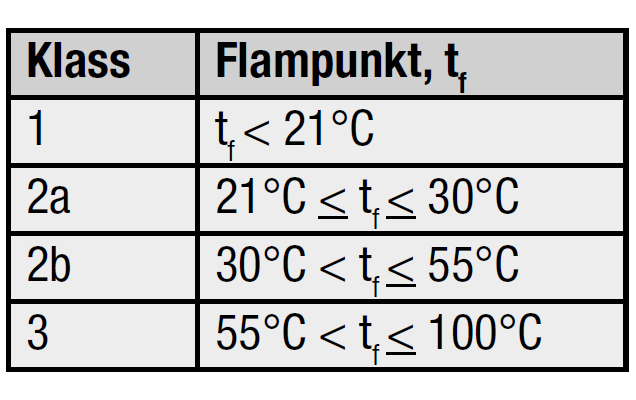
At a normal ambient temperature of 25°C, risk assessments are performed for the handling of flammable gas and Class 1 and Class 2a liquids—i.e., liquids with a flash point up to 30°C. For other liquids, a risk assessment must be performed if the handling temperature is within 5°C of the liquid’s flash point. Information on the flash points of some common flammable liquids can be found in the current edition of SEK Hb 426. The risk assessment includes an evaluation of the concentration in the air of gas or vapor from the flammable goods. If there is a risk that the concentration will exceed 25% of the flammable goods’ lower explosive limit (LEL), a hazardous area arises. Spaces with concentrations above the upper explosive limit (UEL) are also considered hazardous areas if the space is connected to the surrounding atmosphere such that air can enter and lower the concentration. Data on LEL and UEL for some common flammable goods are found in Table 1. For other substances, see the current edition of SEK Hb 426.
Occurrence of explosive dust atmospheres
The regulation AFS 2003:3 contains general advice providing support in applying requirements for handling that can result in an explosive atmosphere. Explosive dust atmospheres can occur where combustible dust or materials that can release combustible dust are handled or stored. For areas with dust atmospheres, it is determined how thick dust layers can form, the lowest ignition temperature of the relevant dust layers and dust atmosphere, whether the dust is electrically conductive, and the ignition energy.

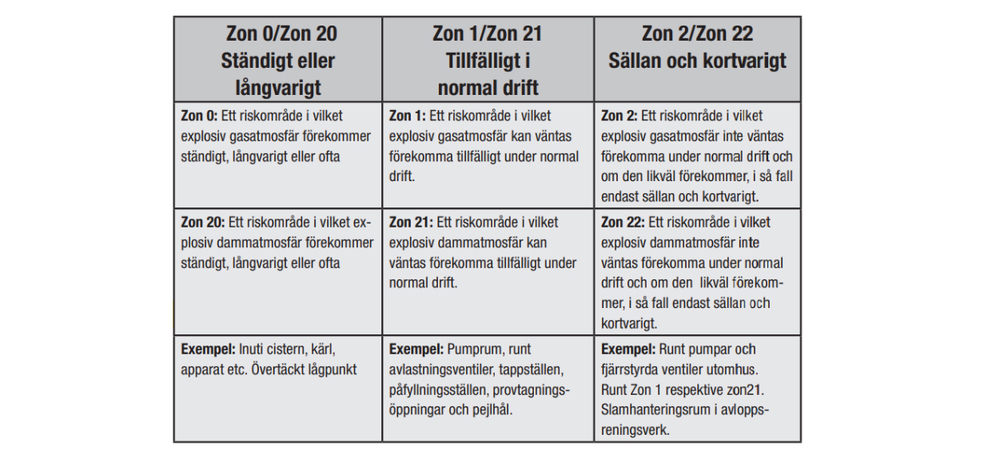
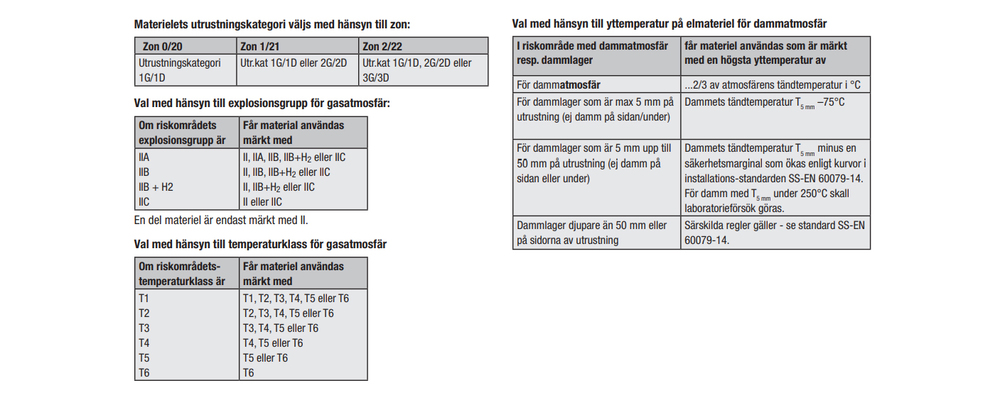
Zoning – A hazardous area is usually divided into zones as follows
Explosion group for gas atmospheres
Flammable goods are divided into explosion groups IIA, IIB, or IIC depending on their ability, as an explosive gas atmosphere, to be ignited by sparks of different energies and their ability to transmit a flame through a gap. Additionally, there is equipment group I, designating conditions in coal mines with firedamp (methane) and coal dust. The division into explosion groups is made to standardize the protective properties of equipment that, in its normal design, could be an ignition source. The types of protection that are always given one of the designations IIA, IIB, or IIC are flameproof enclosure (Ex d), intrinsic safety (Ex i), sparking equipment (Ex nC), and energy-limited equipment (Ex nL). Other types of protection—Ex e, Ex m, Ex o, Ex p, Ex q, Ex nA, Ex nR, and Ex nP—are only given the explosion group designation II. Information on explosion groups can be found in the current edition of SEK Hb 426.

Temperature class for gas atmospheres
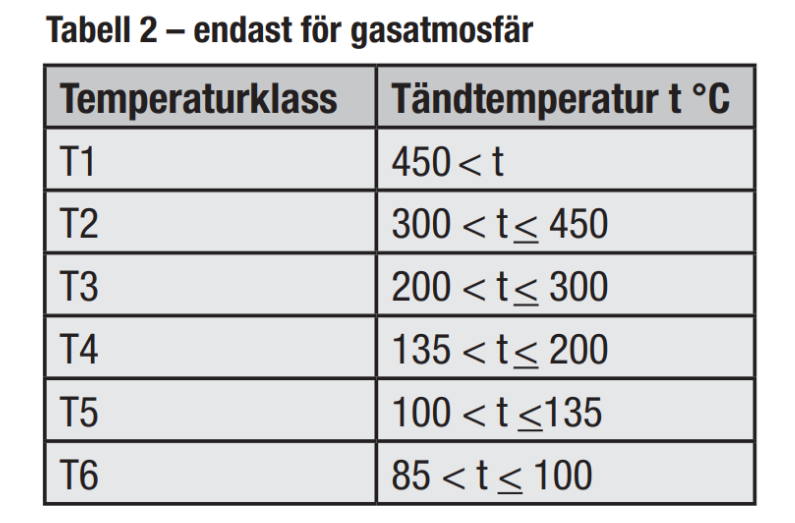
Flammable goods are divided into one of the temperature classes T1 to T6 depending on the substance’s ignition temperature. Ignition temperature (thermal ignition point) refers to the lowest temperature of a surface at which the substance ignites spontaneously (auto-ignition) upon contact with the surface. The relationship between ignition temperature and temperature class is shown in the following table.
Ignition temperature, conductivity, etc., for dust
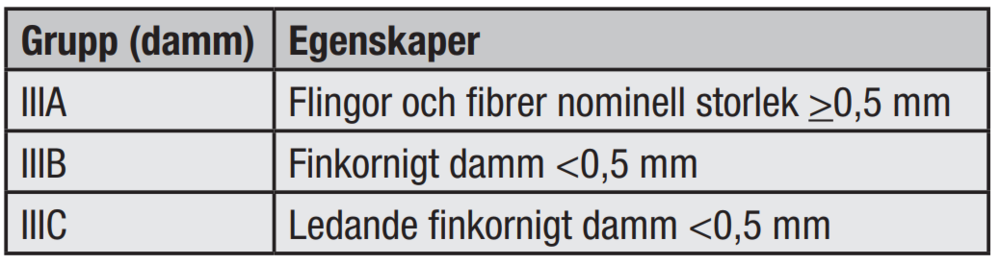
Dust is tested to identify its properties, whether it is combustible, and if so, the ignition temperature of the dust atmosphere and dust layers, conductivity, ignition energy, and dust group (IIIA, IIIB, or IIIC).
Explosive goods
Hazardous areas can also arise when handling explosive goods – hazardous areas with explosives. ATEX regulations do NOT apply; only national regulations do. Explosion-protected equipment can also be used in these hazardous areas, but with additional requirements.
See SS 421 08 24 for classification and SS 421 08 25 for selection and installation of equipment.
Selection of equipment and installation
The information in the classification plan is decisive for the selection of equipment. To provide a safe and technically-economically optimal installation in hazardous areas, good knowledge of the regulations for the execution of the installation and the properties and installation methods of the explosion-protected equipment is required. Knowledge is required during the design of the facility as well as during its installation, operation, inspection, and maintenance. Knowledge requirements for different types of personnel are specified in Annex A of the electrical installation standard SS-EN 60079-14 (SEK Hb 427).
Personnel must be trained, and their knowledge and skills must be documented and maintained through refresher training. Following the current standard is considered to fulfill the safety requirements.
Safety philosophy
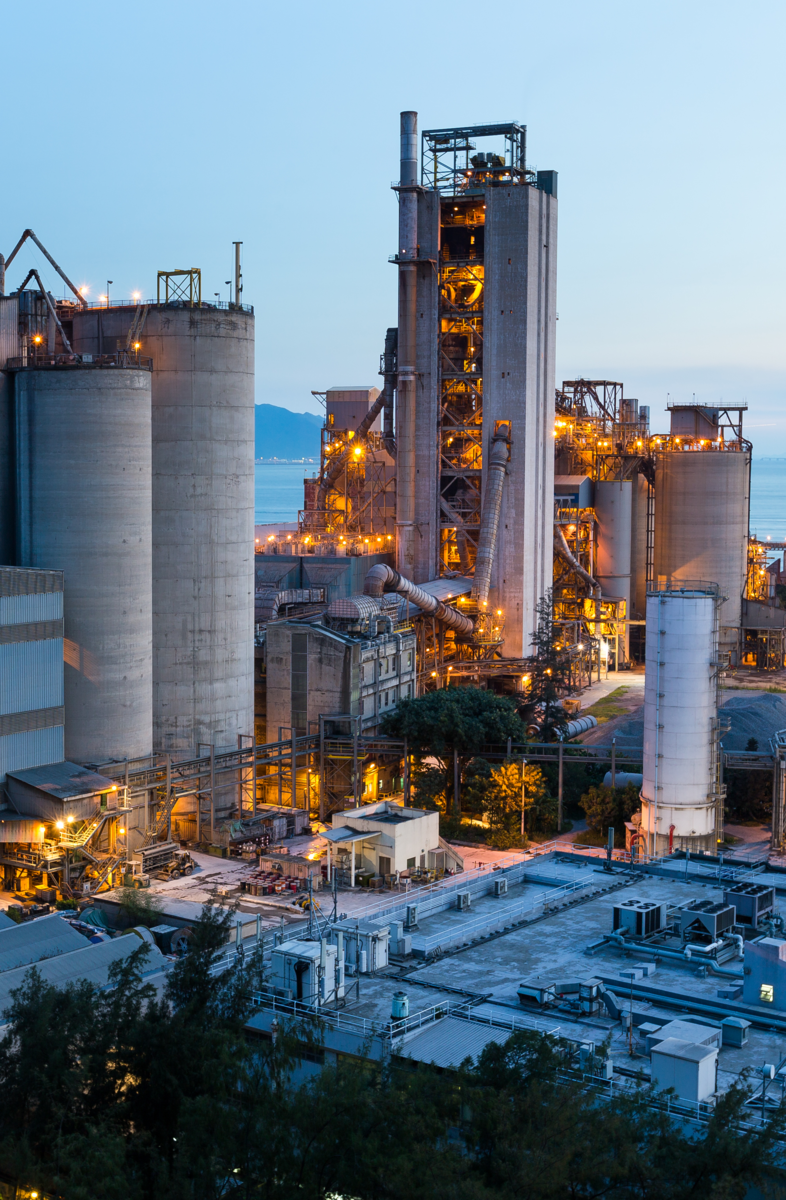
The probability must be sufficiently low for an explosive atmosphere to occur at the same time as the equipment constitutes an ignition source with enough energy—in the form of, for example, a spark, arc, or heat—to ignite the atmosphere. In Zones 0 and 20, a frequent presence of an explosive atmosphere must be expected. The equipment must be of equipment category 1, i.e., such that not even two independent faults can make the equipment an ignition source. In Zones 1 and 21, it must be expected that an explosive atmosphere may occur during normal operation in the process, but not frequently or for long periods. The equipment can be of equipment category 2, i.e., it shall not be an ignition source in normal operation or in the event of a fault. In Zones 2 and 22, it is not necessary to expect an explosive atmosphere to occur during normal operation, and if it does occur, it is likely to be rare and brief. The equipment can be of equipment category 3, i.e., the equipment shall not be an ignition source in its normal operation. Explosion protection can be achieved in various ways, for example by: • isolating the presumptive ignition source from the surrounding atmosphere (Ex m, Ex o, Ex p) • accepting an ignition inside the equipment but ensuring that the explosion does not propagate to the surroundings (Ex d, Ex q) • taking measures that significantly reduce the risk of a fault that would make the equipment an ignition source (Ex e, Ex i, Ex op).
Types of protection for explosion-protected equipment
A variety of protection types for explosion-protected equipment are now internationally standardized.
The standards applicable in Sweden are identical to the European standards (from CEN and CENELEC). Section 5.5 shows various standardized protection types.
Ex- and CE-marked equipment
Compliance of the explosion protection design with ATEX must be verifiable for equipment with an inherent ignition source intended for explosive atmospheres, or which protects equipment in explosive atmospheres. The equipment must be Ex- and CE-marked, and the equipment category must be specified. For mechanical equipment of
category 1 and electrical equipment of categories 1 and 2, a certificate from a notified body/recognized testing institute and a CE declaration are required. For other equipment, a CE declaration is required.
Exceptions to the requirements for Ex and CE marking are:
• Equipment without an inherent ignition source, e.g., pipes and standard electrical cables.
• Components according to ATEX Directive 2014/34/EU
A notified body/recognized testing institute refers to one that is officially accredited by the authority in the country where it is located and notified by that country to the European Commission.
Marking
Equipment for explosive areas is marked, with the exceptions mentioned above. Below we specify what the marking of equipment according to current requirements within the EEA (EU+EFTA) means.
Until 2003-07-01, other equipment could also be put into service. European explosion-protected equipment approved according to Directive 79/196/EEC (from 1979) lacks ATEX marking, including equipment category, but the rest of the marking is similar.
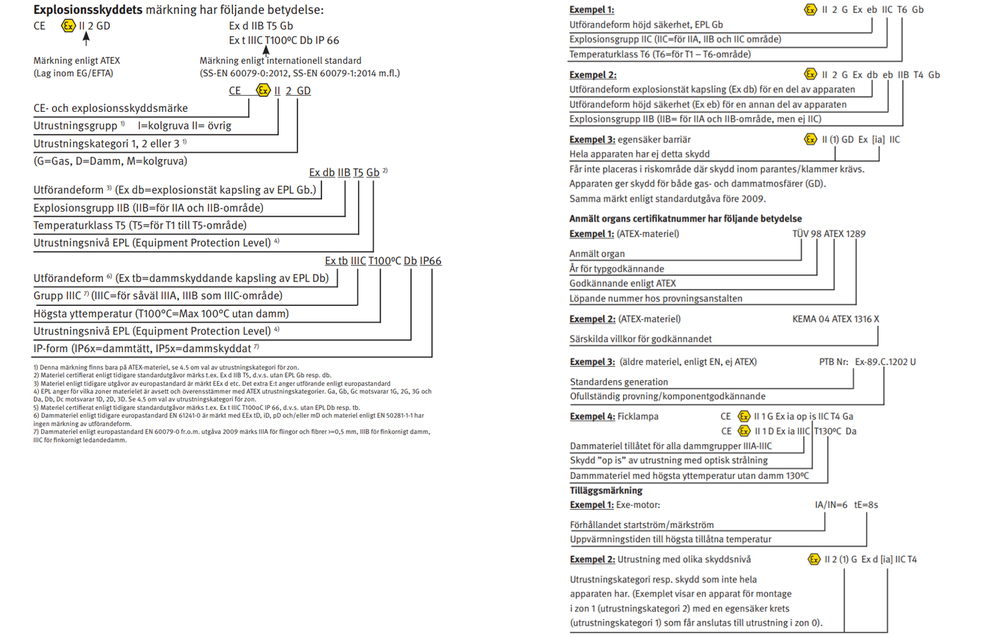
Selection of equipment – For equipment tested with dust layers and tD B… according to previous standards, special rules apply. See the standard.
Occupational safety
The Swedish Civil Contingencies Agency (MSB) is the responsible authority for explosive atmospheres from “flammable goods.” For other explosive atmospheres, the Swedish Work Environment Authority is the responsible authority. (The National Electrical Safety Board is the responsible authority for electrical installations and electrical work risks.) The regulation SRVFS 2004:7… “on explosive environments when handling flammable gases and liquids” and AFS 2003:3 “Work in explosive environments” implement Directive 1999/92/EC in Sweden. The directive is sometimes called the “minimum directive,” the “work directive,” the “user directive,” or “ATEX 153” (formerly 137). Principal measures shall be taken in the following order of priority: • prevent the formation of explosive atmospheres, or where the nature of the activity does not allow this, • avoid the ignition of explosive atmospheres, and • limit the harmful effects of an explosion to ensure the health and safety of workers. The definition of an explosive atmosphere is expanded compared to the directive. This has been done so that the regulations apply to all activities where an explosive atmosphere exists and not just at normal pressure, temperature, and air atmosphere.
Are occupational safety requirements retroactive?
For equipment already in use or provided before July 1, 2003, the requirements for selection according to ATEX categories do not apply; see 2.2. Since July 1, 2006, all workplaces with areas where a significant explosive atmosphere can arise must comply with the requirements for signage, explosion protection documents, and classification.
Risk assessment and explosion protection document
Risk assessments must be documented in an explosion protection document and performed by someone with appropriate training and knowledge. Slightly different requirements are set in AFS 2003:3 and SRVFS 2004:7, with roughly the following meaning: The risk assessment shall include information on: • properties of flammable gas, liquid, and dust • possible ignition sources • the probability of an explosive atmosphere occurring and its duration, • the probability of an explosive atmosphere being ignited and the consequences of the explosion, and • spaces, equipment, installations, materials, or similar deemed significant for the explosion risk.
If safety requires it, these must be designed so that a power failure does not increase the risk of fire or explosions and so that processes and equipment can be shut down manually outside the classified zone. The risk assessment shall also include: • routines for safe handling in explosive environments • required protective equipment and safety measures for each risk source. • areas that have or can have a connection through openings to areas where an explosive atmosphere can arise. • routines for safe management of spills and leaks, and • suitable extinguishing agents and extinguishing procedures in case of fire to prevent explosion.

General requirements
All equipment must be risk-assessed and suitable for the explosive atmosphere in which it is used, and maintained so that the explosion protection is upheld. Equipment and protective systems to be installed in or for Ex-areas shall be selected according to the categories in AFS 2016:4 or ELSÄK-FS 1995:6 (which implement the ATEX equipment directive). The following equipment categories shall be used: in Zone 0 or Zone 20, Category 1 equipment in Zone 1 or Zone 21, Category 1 or 2 equipment, and in Zone 2 or Zone 22, Category 1, 2, or 3 equipment.
The workplace must be designed so that, as far as possible, no one is exposed to risk in the event of an explosion. (An example of this is that load-bearing parts remain intact after an explosion. An explosion should be vented in a controlled manner through, for example, a weaker window or wall section.) Handling, along with associated instructions and routines, must be risk-assessed and suitable for the Ex-environment. The employer shall ensure that anyone present in an explosive environment or performing work that can affect explosion safety has appropriate training, knowledge of explosion risks and protective measures, and skills in safe handling. Knowledge must be updated continuously. Responsibility for electrical safety lies with the holder of the electrical installation.
The risk assessment shall cover normal work and operation as well as expected deviations and faults. (Minimum staffing and the collective level of training for duty personnel to handle foreseen emergencies should not be forgotten.) According to AFS 2003:3, a renewed risk assessment and update of the explosion protection document must be performed • before a change in equipment, routines, recipes, raw materials, organization, or anything else that can affect the risk is implemented, and • after an accident or incident has occurred. According to SRVFS 2004:7, a renewed risk assessment must be performed before a significant change or expansion of the activity. If the explosion risks change, the explosion protection document must be revised. Reorganizations, corporate mergers, and cutbacks are also important to risk-assess so that essential safety work does not disappear. Even normal staff turnover should be risk-assessed to determine if sufficient experience is available in different shifts, etc. A change of material or supplier can affect explosion risks. This may involve a change in the manufacturing method or the presence of other impurities in the product from a new supplier. Such changes can cause problems and should be risk-assessed before the goods are purchased, even if the deviations are acceptable from a quality standpoint.
Explosive areas or premises shall be classified into zones based on how often an explosive atmosphere occurs and how long it lasts. Classification shall be performed according to the current European standard or in another way that provides at least an equivalent level of protection. Such classification shall be documented. If the explosive atmosphere deviates from normal pressure, temperature, or air composition, this must be specifically stated. For temporary workplaces and maintenance of mobile technical devices, according to AFS 2003:3, zone classification does not need to be performed and an explosion protection document does not need to be drawn up. Written safety instructions and appropriate cordoning off shall be implemented if the risk assessment shows it is necessary. Before work begins in a classified area or on safety equipment, a work permit may sometimes be required.
Such a permit shall be issued by a person with specific responsibility for this task. A work permit shall contain the conditions and instructions required for safe handling. (According to AFS 2003:3, a work permit is generally always required for all service and maintenance work in explosive environments, whereas a work permit is normally not required for routine operational work and monitoring. Accidents and incidents shall be investigated, documented, and risk-assessed. Work may not be resumed after an explosion accident or serious incident until a new risk assessment has shown that the work can be performed safely. Routines for safe decommissioning and verification of readiness for operation shall be available and applied during maintenance work or temporary stops of equipment and devices in or for explosive atmospheres.) At a workplace or site with coordination responsibility, the scope of and the person responsible for this coordination shall be stated in the explosion protection document.
Warning sign
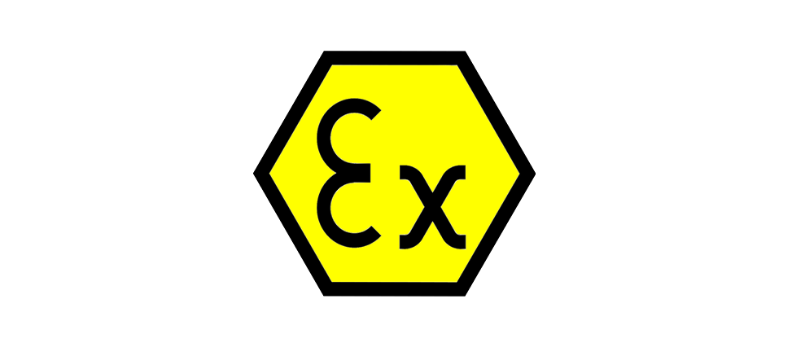
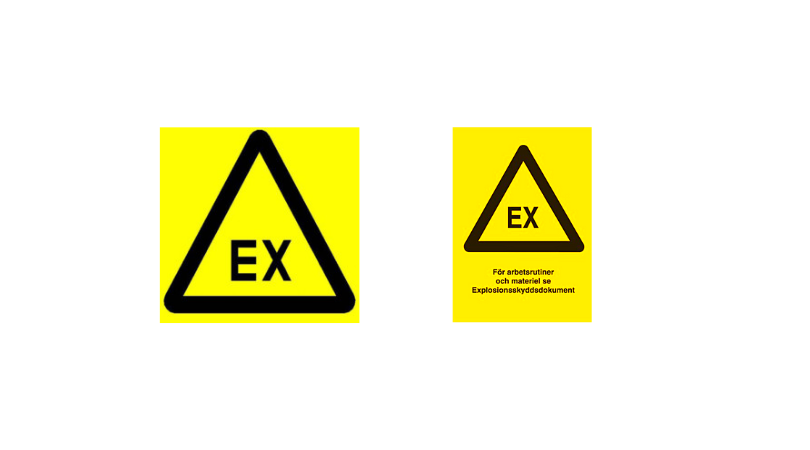
Areas where an explosive atmosphere can arise must be marked with warning signs. The sign shall consist of a triangle with a black border and black letters “EX” on a yellow background. Where AFS 2003:3 applies, it shall have the additional text “For work routines and equipment, see explosion protection document.”
Hazardous areas with explosives
Regulations ELSÄK-FS 2008:1 (until 2017-06-30)
Standards Electrical installations SS 421 08 25
Electrical regulations can be downloaded for free from the internet:
www.elsak.se, www.av.se, www.msb.se
Electrical regulations can be purchased from:
The National Electrical Safety Board’s Publication Shop
Box 4 Tel: 0451-454 27
681 21 Kristinehamn E-mail: order@elsakerhetsverket.se
Standards can be purchased from:
SIS Publishing Tel: 08-555 523 10
118 80 STOCKHOLM
Internet: www.sis.se E-mail: sis.sales@sis.se