
Various grades of crude oil, refined petroleum products such as LPG, and a range of chemicals fall into a category of materials often called static accumulators. Materials in this category are known to be powerful attractors of electrons from other materials and resistant to “releasing” the electrons they come into contact with. In other words, they “accumulate” static charge.
When loading a railway tank, the static accumulating product is transferred from a storage tank via a pipe to a receiving railway container. We refer to the equipment involved in the transfer of the product as the “transfer system.” As the product passes through the transfer system to the railway tank, the molecules in the product become electrostatically charged.
If the railway tank does not have a direct connection to ground, it will create electrostatic charges on the surface, causing the voltage on the railway tank to rise dramatically in a very short time. Since the railway container is at high voltage, it will attempt to find a way to discharge this excess potential energy, and the most efficient way to do this is to discharge the excess electrons in the form of a spark.
Energy discharged in static sparks
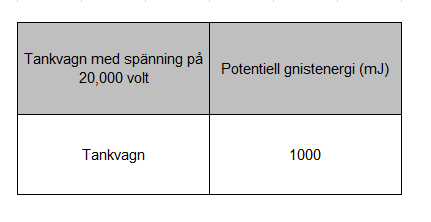
Grounded objects located near charged objects are good targets for electrostatic sparks. An uncontrolled accumulation of static electricity in an EX atmosphere is no different from an engine’s spark plug emitting a spark. If the railway tank is not grounded, its electrostatic voltage can build up to dangerous levels in less than 20 seconds. The table on the right illustrates how much energy can be discharged by a single spark from a railway tank charged to 20,000 volts.
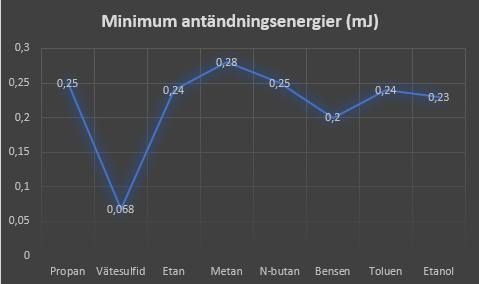
When the energy of the spark caused by static electricity is compared with the minimum ignition energies of a wide range of petroleum products and flammable chemicals, it is easy to see why the railway container and all equipment connected to it, such as hoses and pipelines, should be bonded and grounded. As the image above shows, electrostatically charged railway tanks can release sparks with a large amount of energy. At these energy levels, preventing electrostatic shocks to workers is an important safety issue.
Physiological reactions caused by electrostatic shock can cause a person to trip and fall. This is particularly dangerous when personnel are working above ground level. Of the several factors that contribute to static charging, the one variable that must absolutely be controlled is the grounding of the railway tank. Grounding the tank ensures that the railway container’s resistance to the ground point is maintained at a level that does not impede the safe transfer of static charges from the railway tank to the ground.
In North America, grounding of railway tanks is common practice. In Europe, it is not as consistent. Some sites do it, others do not. Where railway tanks are not actively grounded, it is assumed that the tank on the wagon is well connected to the chassis and that static charges generated by the product transfer can pass from the chassis through the wagon’s wheels to ground or back to the loading platform via conductive connections.
To dissipate static charges from the railway tank, it is expected that the tracks on which the railway container sits have a direct connection to ground or are connected to the loading platform. This equalizes the potential difference between the filling arm and the railway tank. If this is the case, the electrical flow from the railway tank back to the loading platform via the safety-critical connections between the track and the loading site should be verified frequently, preferably before each transfer. Verification of the connection can be done by an electrician with a meter or automatically via a grounding system. So instead of relying on a passive circuit to bond the railway tank to the loading platform, both given methods will ensure isolated rails on which the railway tank rests and identify unsafe contacts before loading occurs.
However, there are many train tank loading sites in Europe where these assumptions cannot be taken for granted, especially when there is uncertainty regarding the track’s connection to ground. Some sites simply do not own the tracks, which prevents engineers from performing grounding tests. Since the loading site does not own the tracks, their engineers are also limited in how much they can “interfere,” i.e., install their own bonding wires from the track back to their property. Instead, the railway tanks are connected to the loading site with static grounding systems. The loading site itself should also be grounded, so that all static electricity is conducted directly into the ground via the loading platform. Other sites in Europe choose to ground their railway vehicles because the ground where the track runs does not have a reliable connection to earth. Therefore, they choose to ground the railway tanks with static grounding systems as a matter of good practice.
Industry standards related to static grounding of tank trucks in HAZLOC atmospheres
Working on the assumption that there is good electrical continuity from the tank to the railway vehicle’s wheels, the sections on grounding of railway tanks in IEC 60079-32 and TRBS 2153 recommend a continuous connection between the railway tracks and the loading site that does not exceed 1 megaohm. North American institutes such as the National Fire Protection Association and American Petroleum Institute publish their own regulations to control the risks associated with loading railway tanks in EX/HAZLOC areas. NFPA 77 “Recommended Practice on Static Electricity” (2014) and API RP 2003 “Protection Against Ignitions Arising Out of Static, Lightning, and Stray Currents” (2008) are publications written by committees of EX industry professionals who are recognized experts in the field of static control for hazardous environments. When railway vehicle grounding is referenced, these publications highlight the risk of non-conductive wear pads and bearings that can prevent static electricity from passing from the tank to the railway wheels, resulting in the dangerous accumulation of static electricity on the tank of the railway wagon.
What emerges from the recommendations of NFPA 77 and API RP 2003 is that 10 ohms in the grounding and bonding circuit is the maximum resistance recommended for equipment at risk of electrostatic charging in EX atmospheres. API RP 2003 goes a step further by recommending 1 ohm or less, but if a grounding system with grounding indicators is used, 10 ohms is fully acceptable. This is because the grounding system continuously monitors the resistance in the ground circuit, so that the grounding system can signal the potential risk to the loading operator if it rises above 10 ohms. Another important recommendation is to use interlocks where possible to ensure that transfer does not occur if grounding is not possible. By stopping the product’s movement, the generation source is eliminated, preventing further charging of the railway tank.
Specifying a static grounding system for loading/unloading railway tanks
One of the biggest problems with static electricity is that it is not something operators can see, smell, or hear. Unfortunately, this can promote an attitude of “it can’t happen to me” or “it doesn’t exist” among the personnel operating the processes. A grounding system that combines simple visual “GO/NO GO” communication via a traffic light model with interlock control is the most effective way to control the risk of ignitions caused by static electricity during transfer to and from railway tanks. Interlocking the transfer system with the grounding system is the ultimate protective equipment to ensure that the railway tank is grounded.
Malux recommends Earth-Rite PLUS for bonding railway tanks to loading sites. While displaying the full range of ATEX and IECEx certification for all gas and liquid vapor groups, it also ensures that there is a 10 ohm or less resistance between the railway tank and the product transfer system. By connecting the ground clamp to the railway tank, Earth-Rite PLUS automatically verifies whether the tank is connected to the loading site by delivering a safe monitoring circuit to the system’s approved grounding clamp. The stainless steel ground clamp provides a strong and stable connection to the railway tank and withstands movement caused by vibrations or accidental disconnection.
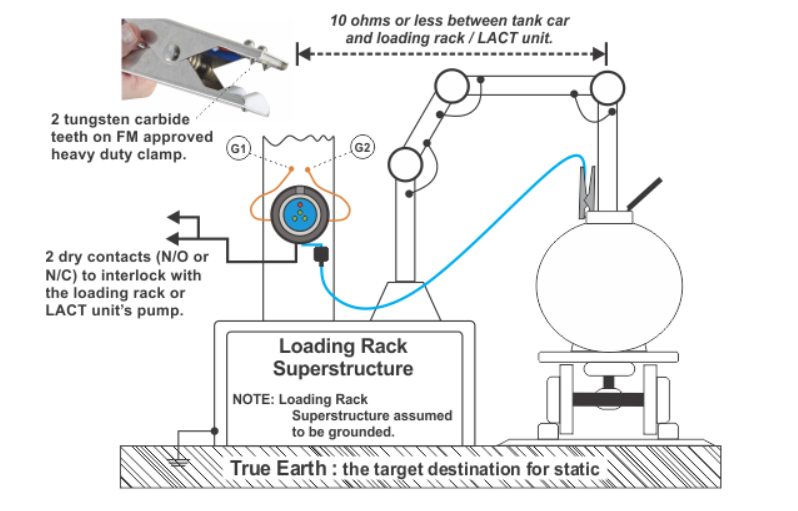
Unlike standard grounding systems that rely on unmonitored ground connections to dissipate static charges, Earth-Rite PLUS ensures that the connection to the loading site is always monitored via the static ground connections G1 and G2 (ref. Fig. 2). When Earth-Rite PLUS verifies that the railway tank is connected to the platform, green LEDs flash continuously to inform the operator that the system is actively monitoring the integrity of the ground loop.
Two free relay contacts can be connected to control the pump or PLCs to stop the transfer if Earth-Rite PLUS detects a resistance of more than 10 ohms in the ground loop between the railway tank and the product transfer system. Shutting down the transfer ensures that the generation of static electricity is stopped, thereby eliminating the risk of the railway tank accumulating a voltage and discharging a static spark.
This article is the copyright of Newson Gale – ©Copyright Newson Gale 2019.