
To achieve and maintain the intended protection against ignition by electrical equipment in hazardous areas, the inspection, testing, and maintenance of equipment, systems, and installations are essential. It should be noted that correct electrical function does not in itself indicate safe use.
Periodic inspections are conducted to eliminate the risk of electrical equipment acting as an ignition source due to accidental damage or unauthorized tampering.
The inspection interval must be adapted to the nature of the facility and the risks of damage, but should not exceed 3 years.
Inspection, testing, maintenance, replacement, and repair of equipment, systems, and installations must be performed by a person with the necessary knowledge of the relevant protection types and their installation and use. Necessary training on the current equipment should be provided on an ongoing basis.
Enclosures or parts of enclosures that provide protection against ignition or protection for live parts must not be opened or removed until the equipment part has been disconnected or the area has been confirmed free of dust, vapor, condensate, or sublimates of explosive substances.
Electrical testing of an equipment part for which the protection against ignition has been disabled shall only take place when the area has been confirmed free of dust, vapor, condensate, or sublimates of explosive substances.
Measures must be taken to prevent unauthorized reconnection of a disconnected equipment part before the part has been restored to its original condition.
It should be noted that equipment may remain energized even after it has been disconnected from a power source, for example, through supply from multiple power sources. For larger rotating machines, generated voltage should be considered so that the machine and associated equipment are not opened until the machine has stopped.
Most power capacitors are fitted with discharge resistors, but it takes a certain amount of time before the final voltage reaches a safe value.
See also the article General installation instructions.
The use of other electrical equipment, for example during testing, repair, and maintenance, is permitted only when the responsible manager has determined that no ignition risk exists.
Following repair, adjustment, modification, or replacement, the part in question must be inspected. If the classification plan is changed or if equipment is moved from one area to another, a new inspection should be performed.
The results of inspection and testing must be documented and made available. Discovered faults must be corrected immediately, and the measures taken must be documented.
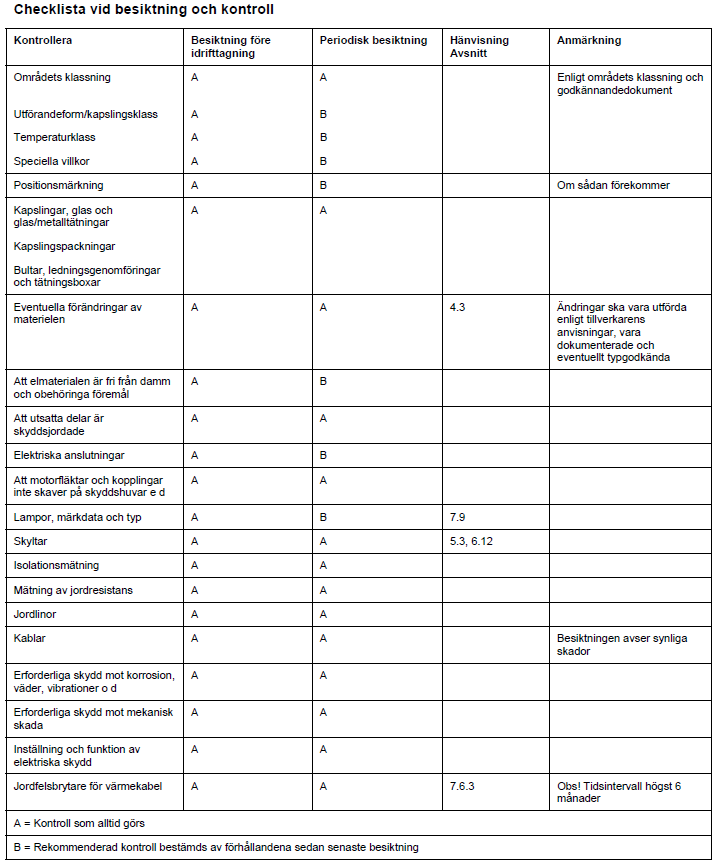
The following checklist is a compilation of commonly required inspection and testing of electrical installations in hazardous areas. Inspection and testing may need to be adapted to the specific facility.
For checklists for facilities with electrical equipment for areas with explosive gas mixtures, please refer to SS-EN 60079-17.
For checklists for facilities with electrical equipment for use in the presence of combustible dust, please refer to SS-EN 61241-17.
SEK Swedish Electrotechnical Standard