
Safety and functionality are, of course, the most important aspects, but today lighting is also part of attractions and the facility’s overall lighting system.
Safety in swimming pools
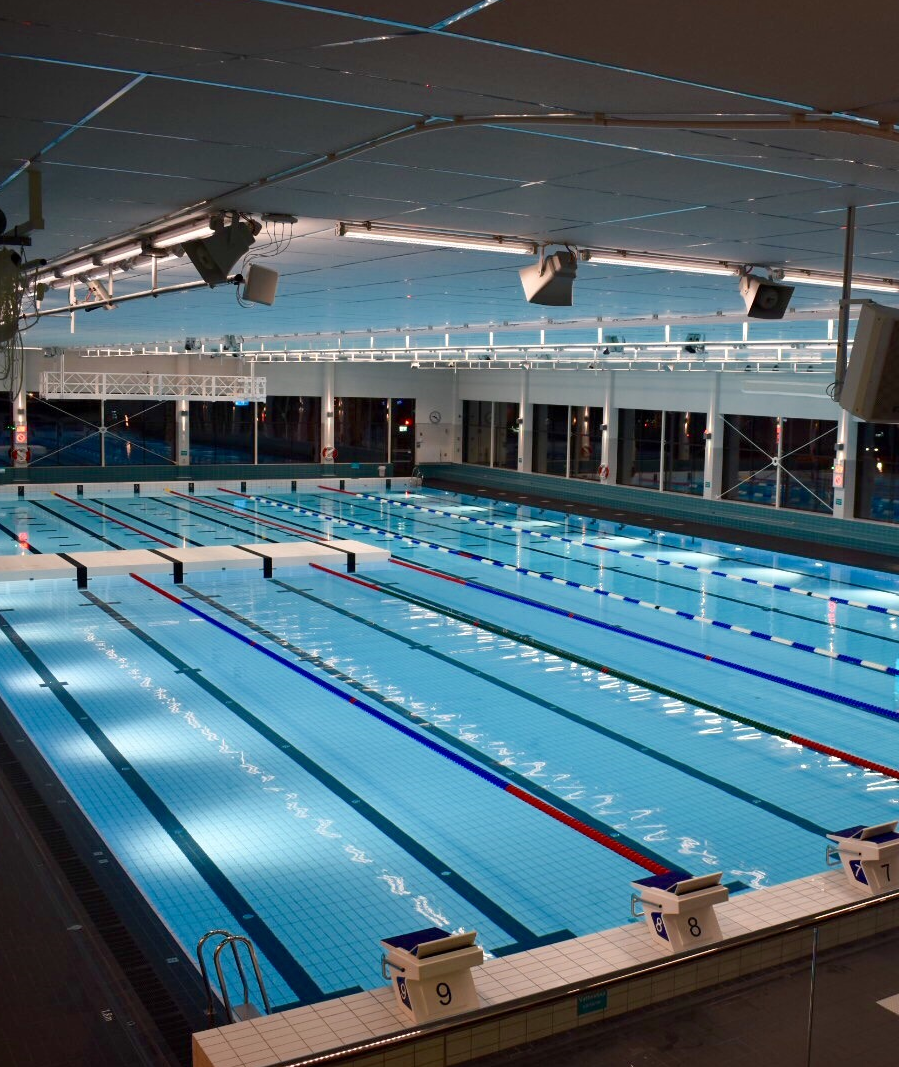
Underwater lighting that effectively illuminates the bottom of swimming pools increases the ability to visually identify people on the bottom—both for staff and for other bathers, who can more easily spot something suspicious and alert staff. Many existing facilities, especially older ones, currently have inadequate underwater lighting and try to compensate with lighting above the pool. The problem is that this both reduces the “coziness factor” and, above all, makes it difficult to push the light down to the bottom of the pool. Most of the light tends to be reflected off the water surface. To achieve the best possible results, the luminaires should be installed below the water surface and be horizontally asymmetric so that they direct the light straight down onto the bottom. In larger pools with a deep section, this technology is even more important in order to illuminate the entire pool and allow the light to reflect upward from the bottom.
Older pools with a service tunnel often have a simpler solution with underwater windows cast into a niche, where a construction floodlight or similar has been hung at the rear. The result is not very satisfactory, since a large part of the light shines straight out and never reaches the bottom. We usually compare this to trying to light the backyard at home by placing a floodlight on a table two metres inside the upstairs floor—it does not turn out as well as you would like. Drowning alarms are, of course, a good complement to the human eye, both in existing facilities and new builds, but when you are there for a rescue operation it is incredibly important to be able to see what is happening below the surface. With purpose-designed, adapted underwater luminaires, the entire pool can be illuminated effectively and identifying people on the bottom is made easier.
Comfort and experience
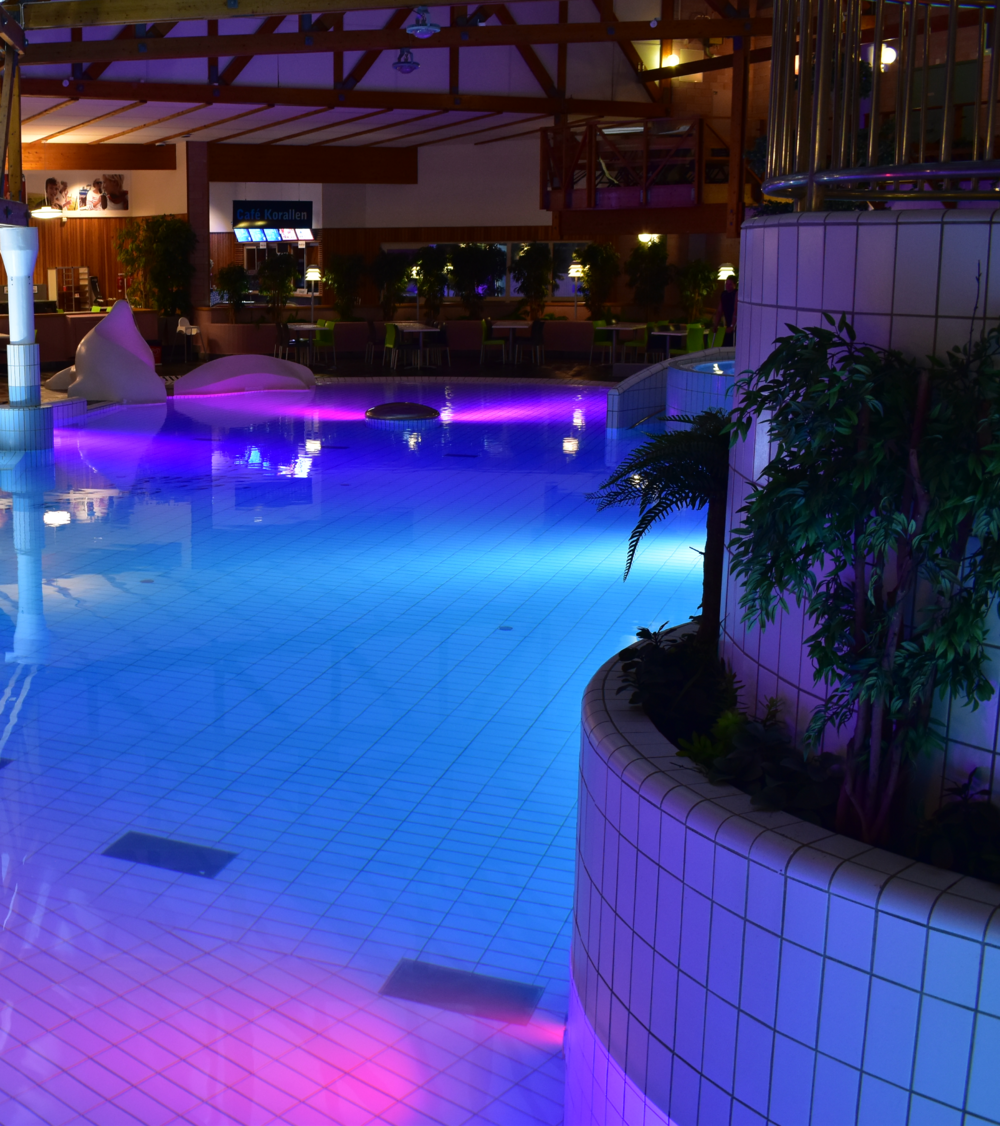
Good underwater lighting not only provides safety, but also increases comfort and the overall experience for visitors. Other general lighting can advantageously be dimmed to make room for the underwater lighting. Since most facilities have large windows, this naturally has the greatest effect in the evening, when there is no daylight/sunlight to compete with. In adventure and experience pools, we primarily work with LED light sources today, where the option to use colour-changing RGB/RGB-W luminaires makes it easy to create highly impactful environments, both above and below the water. Well-designed colour-changing RGB/RGB-W lighting both above and below the water—and above all in interaction with each other—is undoubtedly an attraction in itself and contributes to increased comfort and a better experience for visitors. Kokpunkten in Västerås is an excellent example, where they have made great use of the ability to let all lighting work together for an attractive experience. The image is from Storsjöbadet in Östersund after upgrading to retrofit RGB-W luminaires.
Energy efficiency and maintenance
If we go back a few years, low-voltage halogen and metal halide were the two light sources most commonly used. Low-voltage halogen in adventure sections/rehab, etc., and in pools that lacked a service tunnel. In larger pools with a service tunnel and possible deep section, metal halide luminaires with through-mounting were installed in the best cases. In large lap pools with a deep section and a service tunnel, it is primarily safety and functional light that matter; even today, through-mounting with purpose-designed metal halide luminaires or LED with white light is the best solution for maximum light per watt consumed. An alternative is, of course, to combine functional light with impactful colour-changing RGB-W lighting. In smaller pools and adventure pools, LED luminaires with installation from the water side are used almost exclusively today. Highly efficient LED luminaires with long service life and minimal maintenance are used in most cases. Retrofit luminaires to replace old existing halogen luminaires, regardless of brand, are available; they both reduce energy consumption and provide better light.
What should I choose, and how should I position it?
To determine which type of lighting you should choose, it is always best to start from the intended use of the pool. Lap and competition pools usually require, as mentioned earlier, powerful and functional lighting, especially in pools with a deep section. In adventure sections and rehab pools, requirements are usually set for functional lighting combined with comfort and experience. Therefore, LED luminaires are most often used in these pools, and today you can advantageously choose RGB-W luminaires that allow both colour changing and white light in the same luminaire. Colour-changing luminaires should preferably be used in “abundance”, as it usually looks best when the water is clearly coloured and not only in parts of the pool. Reflections off the bottom and walls are an important factor to consider when positioning luminaires. Generally speaking, it is easier to achieve a good lighting result with light-coloured pool materials, since it is easier to distribute the light using reflections.
Darker pool materials are, of course, attractive in their own right, but they also “absorb” the light and make the light source itself stand out more clearly, which means that approximately 40% more luminous flux is required to achieve an equivalent result. It is often an advantage to use more light points to achieve more even lighting, as reflections do not occur in the same way as in a light-coloured pool. Bottom-mounted luminaires in pools deliver an impactful result on the pool area ceiling, especially with higher ceiling heights and light-coloured ceilings. The movement of the water surface and refraction of the light create very attractive, striking reflections on ceilings and walls above the surface. For wall mounting, the luminaires are generally positioned approx. 600–1000 mm below the water surface, and if possible it is always advantageous to position the luminaires so that they are directed away from the viewer’s eyes. In larger pools, however, it is often necessary to position luminaires from several sides, preferably the long sides.
Which type, how many, what is required?
In practice, there is no real standard for underwater lighting and its intensity; requirements are often set for the lighting just above the water surface. However, there are often general local recommendations and requirements for different types of purposes and pools.
Unfortunately, there are several interpretations of what is considered good underwater lighting, and they naturally vary depending on who is interpreting. When we carry out our designs and lighting proposals, we base them both on our many years of experience and on our reference facilities, combined with a lighting calculation based on lumens/m².