
The “Product Directive” came into force in 1994, and the “Work Directive” came into force in 1999. Someone, probably a Frenchman, summarized these laws with the term ATEX (ATmosphere EXplosible)
When there is a risk of an explosive mixture of gas or dust, the facility owner or the party using the premises is obliged to ensure that a classification plan is prepared for that area. This “classification” then determines the requirements placed on the equipment to be installed within the area. Depending on how often there is a risk of explosion in the area, it is divided into zones. The heat emitted by installed equipment is a source of ignition for the explosive substance. Therefore, the ignition temperature of the substance and the hottest point of the equipment must not be too close to each other. For this reason, temperature classes must be specified.
The speed and pressure of an explosion also vary, which means that the substance’s explosion group must be specified. When the installer then selects equipment/product, they review the Ex certificate and the product nameplate and choose the version that matches the classification. How the marking on the nameplate should appear is determined by the certification and is stated in the Ex certificate. Standards and handbooks are available as guidance for installation and maintenance.
Classification plan
To clearly show where the risk areas are and to document this, it must be possible to see on layout plans and building drawings how these so-called zones extend. The zones—six in total—are marked with lines, squares, and circles on the drawings so that the correct equipment can be selected for a specified installation location. Note that it is not only in the horizontal plane that it is important to see the zone boundaries, but also vertically. With heavy gases, for example, the lighting may not need to be Ex-rated, while with light gases, it is precisely the lighting that is most important to choose correctly.
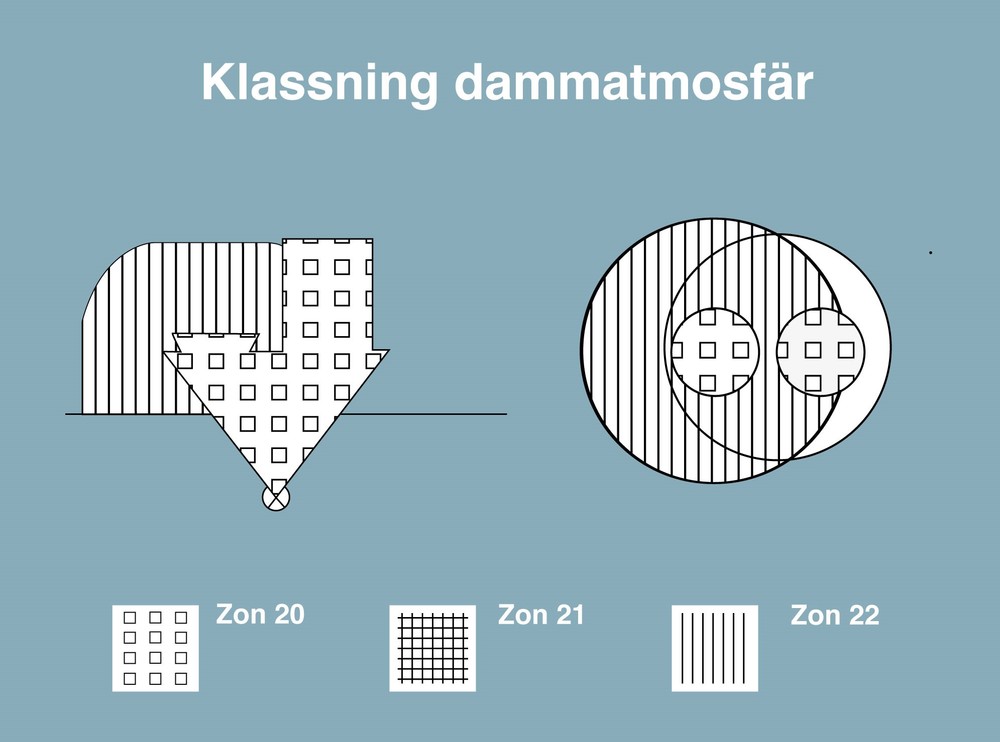
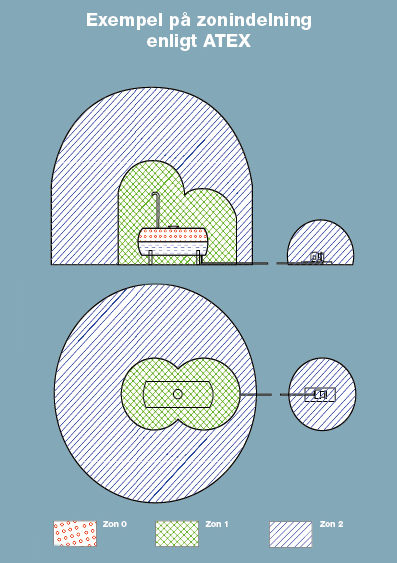
ZONES
Explosive gases: Zone 0 Hazardous area in which an explosive gas atmosphere is present continuously, for long periods, or frequently. Zone 1 Hazardous area in which an explosive gas atmosphere is expected to occur regularly or occasionally during normal operation. Zone 2 Hazardous area in which an explosive gas atmosphere is not expected to occur during normal operation, but if it does, it is only for a short duration. Explosive dust: Zone 20 Hazardous area in which an explosive dust atmosphere is present continuously, for long periods, or frequently. Zone 21 Hazardous area in which an explosive dust atmosphere is expected to occur regularly or occasionally during normal operation. Zone 22 Hazardous area in which an explosive dust atmosphere is not expected to occur during normal operation, but if it does, it is only for a short duration.
Temperature class
Flammable substances such as gas, vapour, or dust are divided (classified) into different temperature classes according to their ignition temperature—that is, the lowest temperature at which the substance self-ignites upon contact with a surface. T1 is the lowest class and T6 is the highest class. Explosive gases: T1 450°C< ignition temperature for the gas T2 300°C< ignition temperature for the gas <450°C T3 200°C< ignition temperature for the gas <300°C T4 135°C< ignition temperature for the gas <200°C T5 100°C< ignition temperature for the gas <135°C T6 85°C< ignition temperature for the gas <100°C Explosive dust: Written in plain text as the number of degrees (e.g., 65°C)
Standards and handbooks
EN IEC 60079-0 General requirements EN IEC 60079-1 Exd Flameproof enclosure EN IEC 60079-2 Exp Pressurized enclosure EN IEC 60079-5 Exq Sand filling EN IEC 60079-6 Exo Oil immersion EN IEC 60079-7 Exe Increased safety EN IEC 60079-11 Exi Intrinsic safety
EN IEC 60079-15 Exn Type of protection for Zone 2 EN IEC 60079-18 Exm Encapsulation EN IEC 60079-10 Handbook 426 Classification of hazardous areas EN IEC 60079-14 Handbook 427 Design of electrical installations EN IEC 60079-17 Handbook 427 Maintenance of electrical installations EN IEC 60076-32 Handbook 433 Static electricity in hazardous areas
Explosion group
Flammable substances are classified into explosion group IIA, IIB, or IIC based on the energy with which they can be ignited by sparks and their ability to propagate a flame through a gap. This classification is used to standardize the protective properties of equipment that could normally be an ignition source. Group I refers only to methane–air mixtures in mines. Group II is divided into different subgroups depending on the type of gas mixture, where IIC is the highest-risk group.
Explosive gases:
IIA E.g., propane, butane, kerosene, aviation gasoline, and methane
IIB E.g., carbon monoxide, ethanol, ethene, and acrylic acid
IIC E.g., hydrogen, acetylene, and carbon disulfide
Dust is classified in a different way.
Explosive dust:
IIIA Combustible dust particles larger than 0.5 mm
IIIB Non-conductive dust particles smaller than 0.5 mm
IIIC Conductive dust particles

Type of protection
There are several ways to design a product to reduce the risk of explosion when it is to be used in a process. Exd Flameproof enclosure. The enclosure is manufactured robustly enough to withstand an internal explosion without spreading the hot gases outside the enclosure. Exp Pressurized enclosure. Overpressure with clean air must always be maintained within the enclosure to prevent gases or dust from entering from the outside. Exq Sand filling. The ignition source, e.g., a contact, is surrounded by small sand grains, which cool the hot gases on their way out. Exo Oil immersion. The product, e.g., a transformer, is completely surrounded by oil that insulates it from the ambient air.
Exe Increased safety. For example, a junction box, which should normally not be able to produce any sparks, has been manufactured in an extra safe way with regard to strength and insulation distances. Exi Intrinsic safety. At the beginning of a circuit, there is an energy-limited barrier. The energy is so strictly limited that not even a short circuit is enough to create an explosion in the hazardous area. Exn Type of protection for Zone 2. Exn is a common designation for various types of protection for Zone 2 (ExnA, ExnC, ExnR, ExnL, and ExnP). Exm Encapsulation. An electrical coil, for example, can be completely encapsulated and not come into contact with the ambient air.

Marking
The product must have marking that complies with the Ex certificate.
It must include:
– Manufacturer’s name and address
– Type designation for the product
– EX certificate number
– Year of manufacture
– Type of protection
– CE marking with the number of the testing institute for the manufacturing company’s quality.